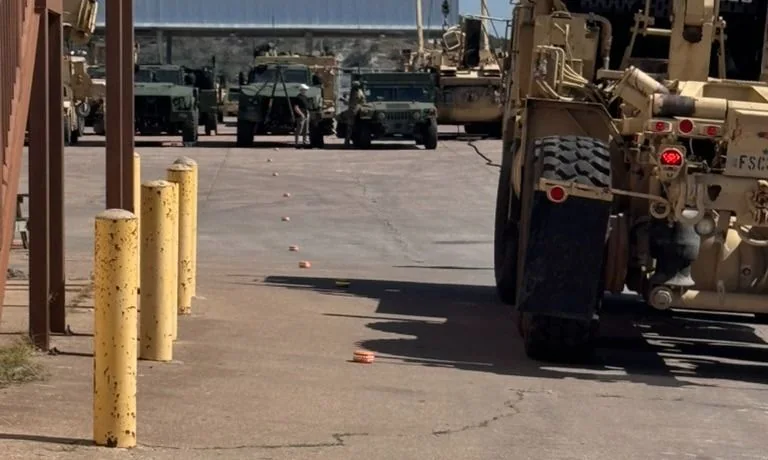
Tested with Soldiers, in the field.
Same marker, discrete EO/IR light signatures.
Images from emplacement trials. Hover a plate to inspect, click to enlarge.Images from emplacement trials. Tap any plate to enlarge.
Core workflow demonstrated, including mesh networking and TAK. Markers observed at ~500 m against ~20 m for current-issue equipment.
Thermal signature demonstrated through Bradley thermal optics.
Operational workflow demonstrated directly with engineer Soldiers.
Detection range drives passage speed.
A lane a driver cannot see at speed is a lane that slows the formation. The range figure below was observed against current-issue marking equipment under the same conditions.
Detection range
Markers acquired at ~500 m against ~20 m for current-issue equipment, Gen III NVG, no IR illuminator.
Dismounted exposure
Less time on foot in the lane during marking and follow-on movement.
Spectral bands
One marker read by the unaided eye, image intensifiers, and thermal optics. No separate marker for each optic.
Reduces the time a Soldier must work exposed on the breach lane during marking and follow-on movement.
A lane visible at range lets follow-on vehicles hold speed and spacing instead of bunching at the entry point, where a breach is most vulnerable.
Lane geometry published to TAK means the breach is a known object on the common operating picture, not a radio call and a grid coordinate.